
What’s the best ERP for an omnichannel CPG brand today?| What I learned building Fulfil for CPG brands
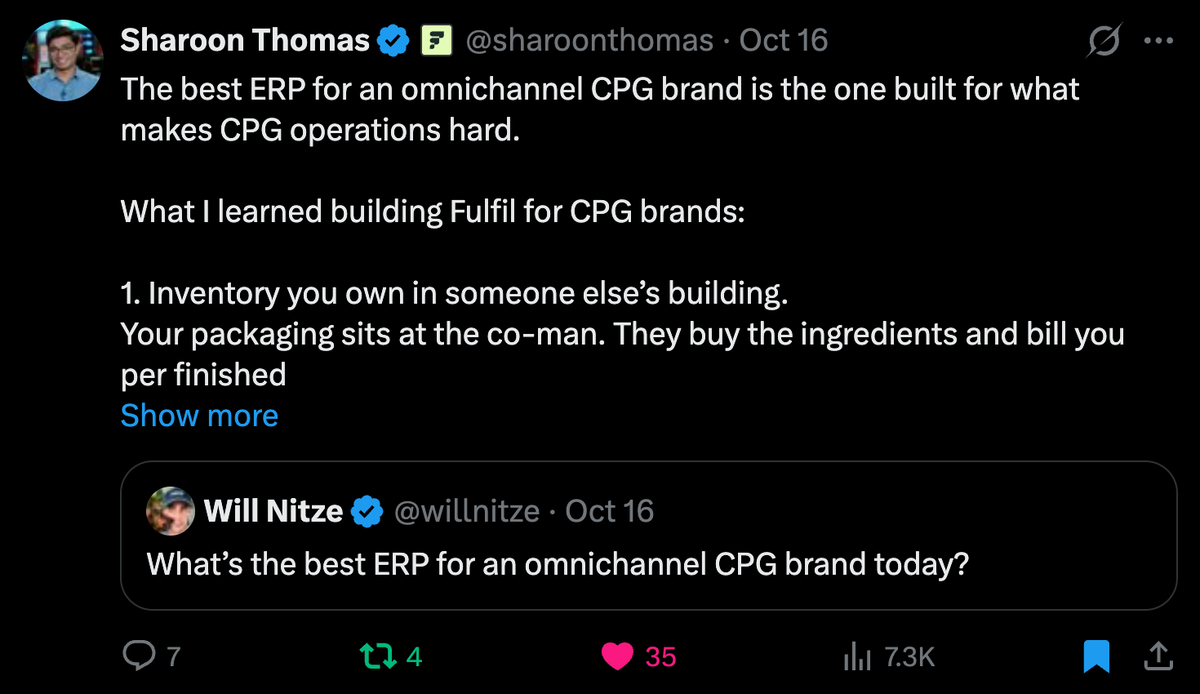
The best ERP for an omnichannel CPG brand is the one built for what makes CPG operations hard.
What I learned building Fulfil for CPG brands:
1. Inventory you own in someone else’s building.
Your packaging sits at the co-man. They buy the ingredients and bill you per finished unit. Your real unit cost is packaging consumed + their invoice. In Fulfil, receiving finished goods consumes the packaging off the BOM, so the cost lands on the inventory.
2. Getting paid less than you invoiced.
You invoice Target $10,000. They pay $9,400. The $600 is cartons they say never arrived, damaged units, labeling fines, an early-pay discount. The reasons come in a remittance file (EDI 820), one line per deduction.
Someone used to match each one to its invoice by hand. Now an agent reads the 820 and matches each line.
3. Shelf life that depends on who’s buying.
A jar with 3 months left is fine for a DTC customer who’ll finish it this month. Amazon will reject it at receiving. Same batch: sellable on your site, unsellable on Amazon. In Fulfil you set a minimum shelf life per channel, and every order gets the oldest stock that still clears it.
4. Not knowing which customer got which batch.
Every run gets a lot number printed on the pack. If a run goes bad, you need to know exactly who got it. Many 3PLs pick from several lots at once and never record which went in which box. So in a recall you email everyone who ordered in that date range and pull far more product than you need to.
5. Components.
One spray bottle is a bottle, pump, cap, label and carton, each from a different supplier with its own lead time. If one part is short, the co-man can’t start the run. Your hero SKU goes out of stock over a cap that costs a few cents.
6. Inventory you have but can’t sell.
A lot of CPG goes on QA hold coming off the line and sits until a third-party lab clears it. If planning counts it as available, you stock out with full pallets in the building.
7. Bundles that behave differently by channel.
On Shopify, a 3-pack is picked as 3 singles at pack time. Amazon and Walmart need it built ahead as its own product with its own barcode, so it carries its own cost, including kitting labor and packaging. Planning has to account for both.
8. Retailer purchase orders over EDI.
Walmart sends weekly POs (850). Some ship to a DC and then on to a specific store, and the carton label has to show both. When you ship, you send an ASN with carton-level detail (856). Then an invoice (810). When they pay, net of deductions and chargebacks, you get a remittance (820). Manually created ASNs is a huge source of chargebacks.
Each retailer’s rules live in a long routing guide PDF. AI can read it and turn it into label rules in Fulfil, so you don’t learn them from chargebacks.
9. One product, several barcodes.
Every retailer has its own barcode and labeling rules. Separate packaging per channel multiplies your SKUs and your MOQs. Print for your strictest channel. You can always cheaply relabel for the rest. And please get your UPCs from GS1 (not reseller). Every packaging level gets its own GTIN: the unit, the inner pack, the case.
If your ERP can’t do these natively, you’re doing them in spreadsheets.